The Open Health Stack gets a home of its own, and we helped build the house
On July 9, the Linux Foundation announced its intent to launch the Open Health Stack Software Foundation (OHS-SF), a vendor-neutral, community-governed home for the open-source software developers use to build standards-based, AI-enabled digital health solutions. Google is contributing the entire Open Health Stack project, including its code and assets, alongside a $3 million grant from Google.org, and the foundation launches with the backing of the World Health Organization and more than twenty organizations across global health and technology.
Nawi is one of them. Our team is named among the active implementers already building in the field on the foundation's launch announcement, and we could not be prouder of what this milestone represents.
Why this matters
Digital health infrastructure remains fragmented. Every ministry of health, NGO, and implementing partner that sets out to digitize a health program faces the same foundational problems: capturing structured clinical data offline, exchanging it across systems that speak different languages, and turning it into information that decision-makers can act on. The Open Health Stack, launched by Google in 2023 in collaboration with WHO, answered those problems with shared, open building blocks grounded in the HL7 FHIR standard.
Moving the project to the Linux Foundation, the home of the Linux kernel and Kubernetes, means those building blocks now belong to the community that depends on them. No single company owns the commons. Governance is open, funding is diversified, and the roadmap is set by the people doing the work, including implementers in the low- and middle-income countries where these tools matter most. The foundation's Implementer Program goes further, removing fee barriers so that small companies and pre-revenue startups in those countries can participate directly in governance.
The foundation organizes its work into three pillars: FHIR Foundations, the core libraries and SDKs for building with HL7 FHIR; the Reference Toolkit, a community-driven, multiplatform toolkit for building and deploying localized solutions; and AI Commons, a neutral, model-agnostic space for safe and verifiable AI in global health, co-developed with WHO.
Our part in the story
For our team, this announcement is personal. Long before Nawi existed as a company, our engineers were the core digital health engineering team at Ona, where we built OpenSRP 2, a FHIR-native platform for frontline health workers, directly on the Open Health Stack. That work made us daily contributors to the stack's foundational components: the Android FHIR SDK that powers offline-first structured data capture, the FHIR Gateway that secures data exchange between mobile clients and FHIR servers, and the analytics pipelines that turn FHIR data into insight.
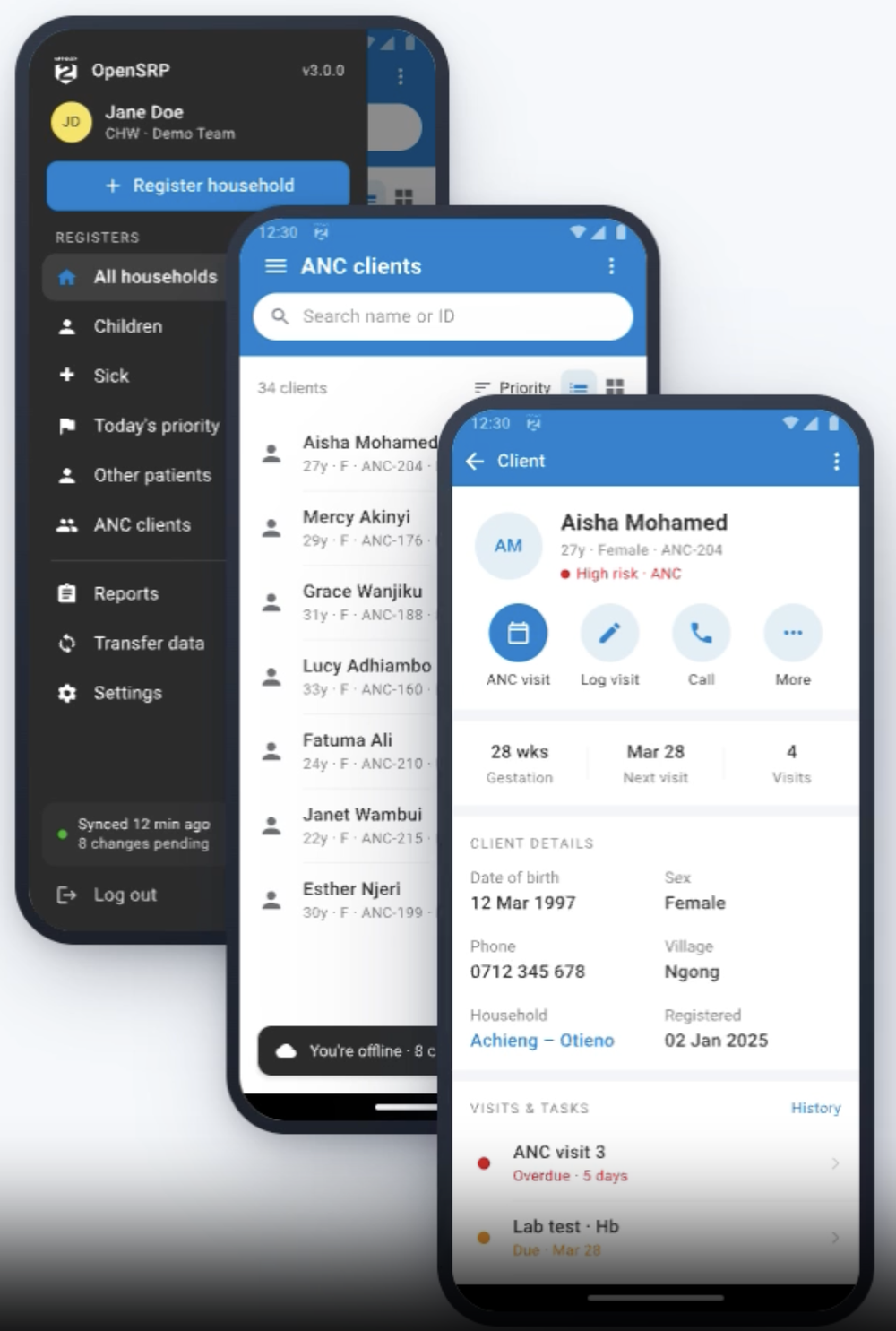
OpenSRP 2 in the hands of frontline health workers: registers, client records, and offline-first sync, built on the Open Health Stack.
That contribution continues at Nawi. We are actively contributing to the OHS Player, the reference application at the heart of the foundation's Reference Toolkit pillar. This work is aimed at making it dramatically easier for any team, anywhere, to stand up a standards-based digital health solution across Android, iOS, and the web.
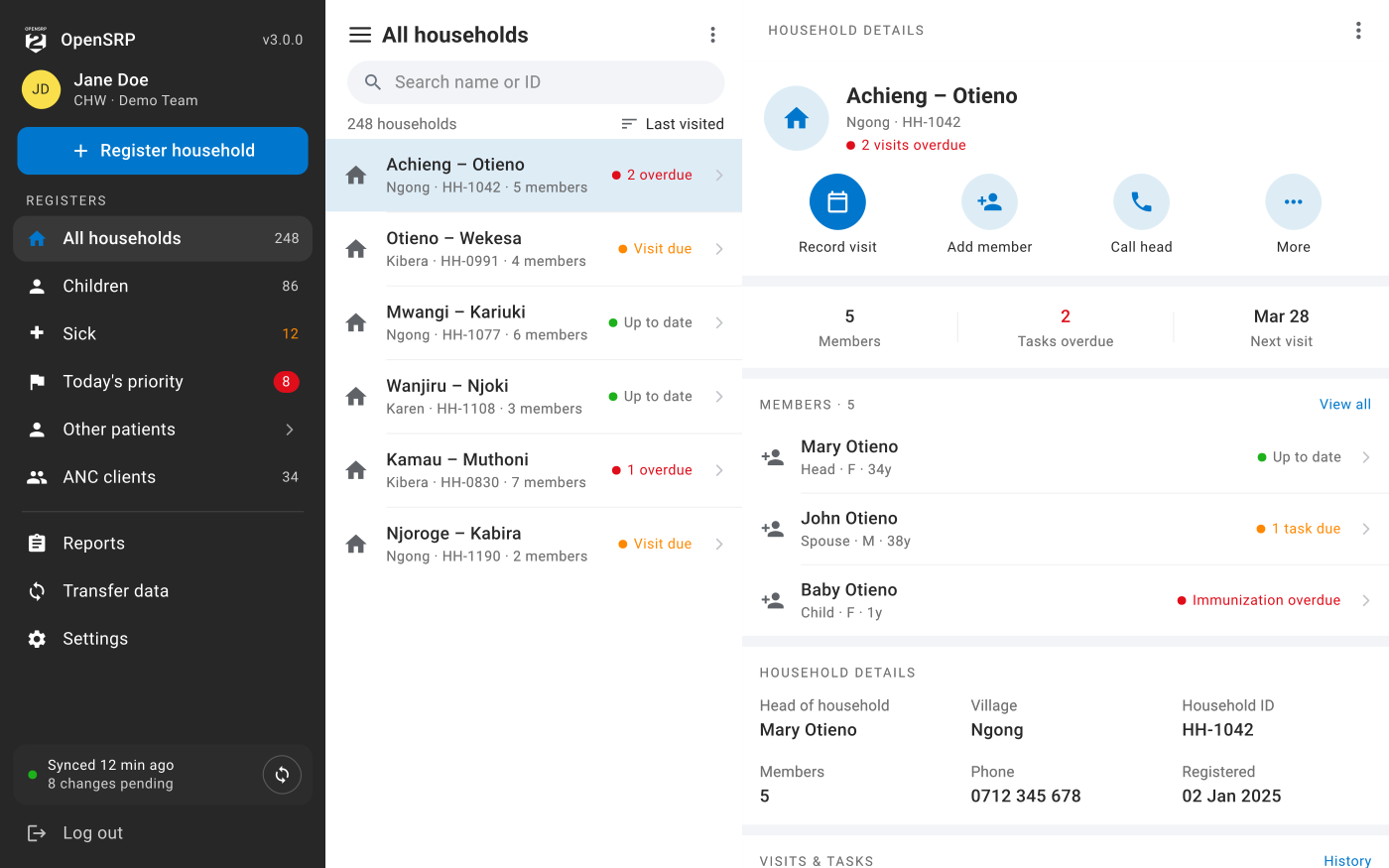
The same solution adapting to larger screens: registers and client details side by side for facility and supervision workflows.
We have also seen what these building blocks do in the real world. Solutions our team has helped build on the Open Health Stack run at national scale in countries and have supported care for hundreds of thousands of patients, from child care, community based disease surveilance, immunization and maternal health programs to community health and supply chain monitoring.
What comes next
The foundation is open for participation, and the building blocks are ready. The repositories are public at github.com/ohs-foundation, and the foundation's work is laid out at ohs.foundation.
For governments, development partners, and health organizations: if you are planning a digital health investment, the case for building on open, standards-based foundations has never been stronger. It is the path to systems you own, that interoperate with your national architecture, and that no vendor can take away from you.
We have helped partners do exactly that for years, and as the Open Health Stack enters this new chapter, we would be glad to help you do it too. Talk to us.